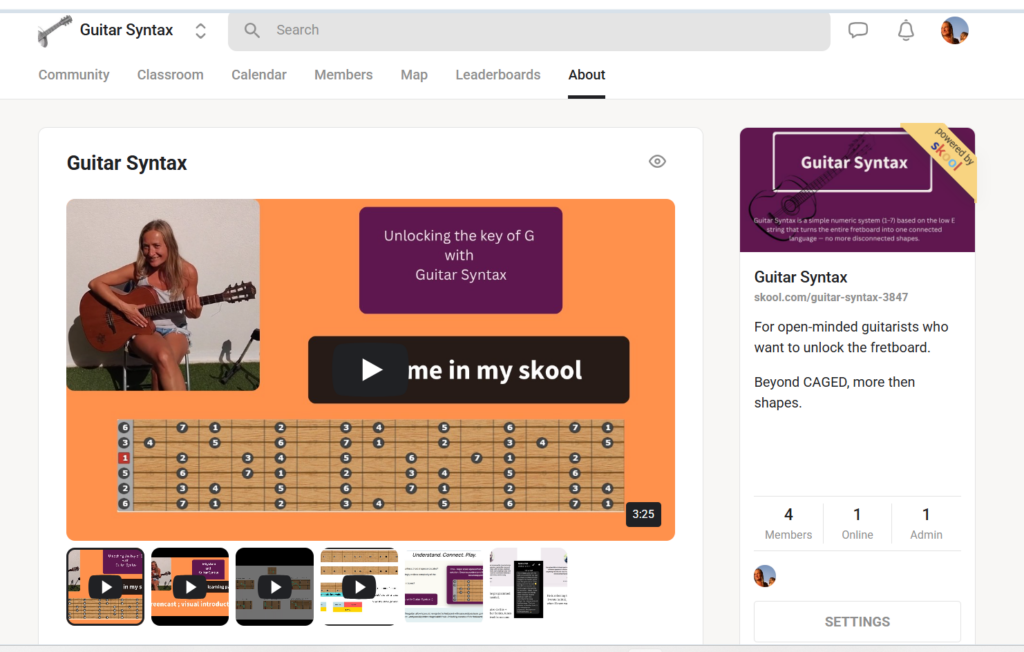
The E-System is a different way of seeing the guitar: the fretboard as one connected whole, built on logic instead of scattered memorization.
Most guitar players don’t struggle because they lack passion or practice. They struggle because the fretboard feels like a bunch of disconnected “areas” that only make sense in small boxes. You learn a scale shape here, a chord grip there, and you get results—but only in the narrow lane that pattern lives in. There is another way.
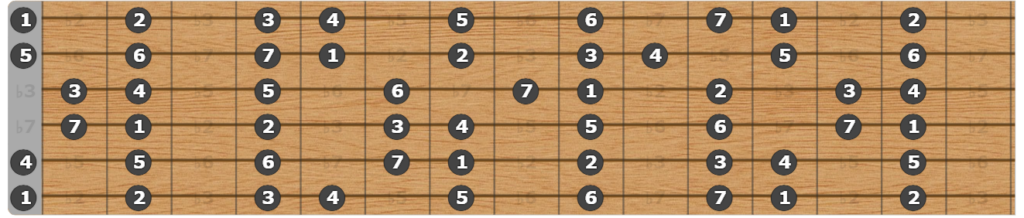
At the center of the E-System is a simple foundation: numbers.
Specifically, the numbers 1–7 represent intervals—the real building blocks behind scales, chords, and harmony. Instead of thinking “this is a random shape,” you start thinking “this note is the 1, this one is the 3, this one is the 5,” and so on. Once you assign a key note as number 1, that 1 becomes the leader—the tonal centre that everything else relates to.
From there, the major scale becomes your base structure.
The major scale isn’t just another scale to memorize; it’s the foundation of western harmony, and it’s the cleanest place to understand how the numbers behave. With the 1–7 system in your hands, the major scale stops being a pattern and becomes a map: a clear layout of intervals that you can place anywhere on the neck.
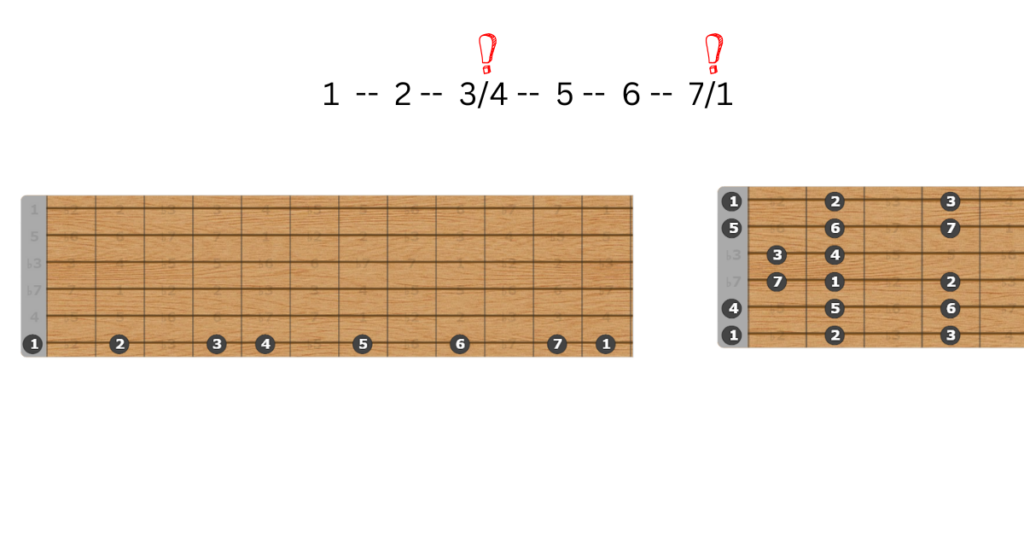
Modes fit into this naturally.
Instead of treating modes like seven separate mysteries, the E-System approach is straightforward: the same system, just start from a different number. You’re not learning a new universe each time—you’re rotating the perspective while keeping the same underlying logic. That’s where the fretboard starts feeling less like memorized “positions” and more like one flexible environment.
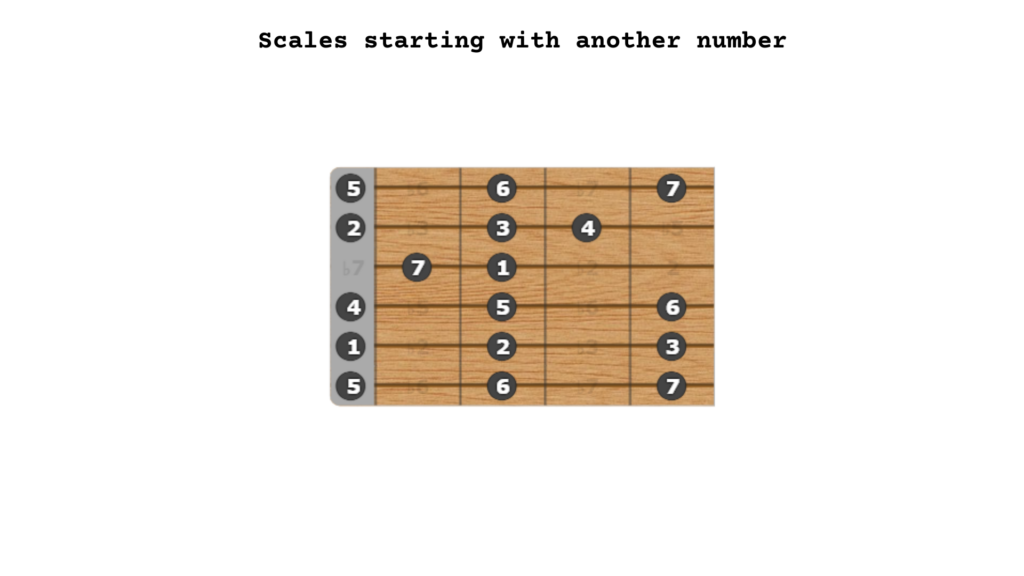
Chords are where the E-System really shows its power.
A key idea here is that there are only five major chord shapes, and those shapes come straight out of the major scale applied across the strings. But the bigger unlock is what you do with them: you don’t just collect shapes—you understand what’s inside them.
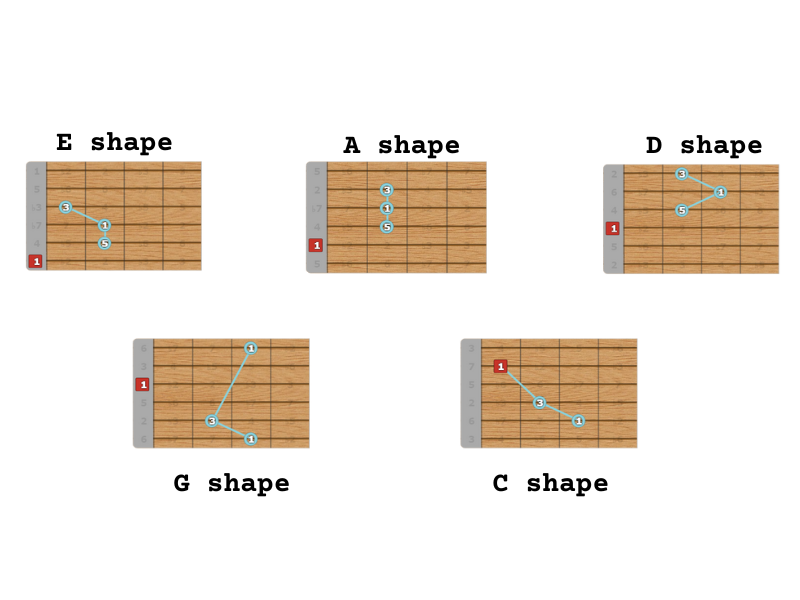
That’s where the nucleus concept comes in.
When you see a chord shape as a structure built around a “5-1-3 nucleus,” you can start modifying that core to create a huge range of chords without starting from scratch every time. You’re not hunting for brand-new grips; you’re customizing a known structure with purpose.
Even better, the major scale naturally gives you the core chord types you’ll run into again and again: major, minor, dominant 7, and m7b5. Instead of learning these as isolated formulas, you see them as things that already exist inside the scale’s harmonic world. That makes chord construction feel less like theory homework and more like common sense on the neck.
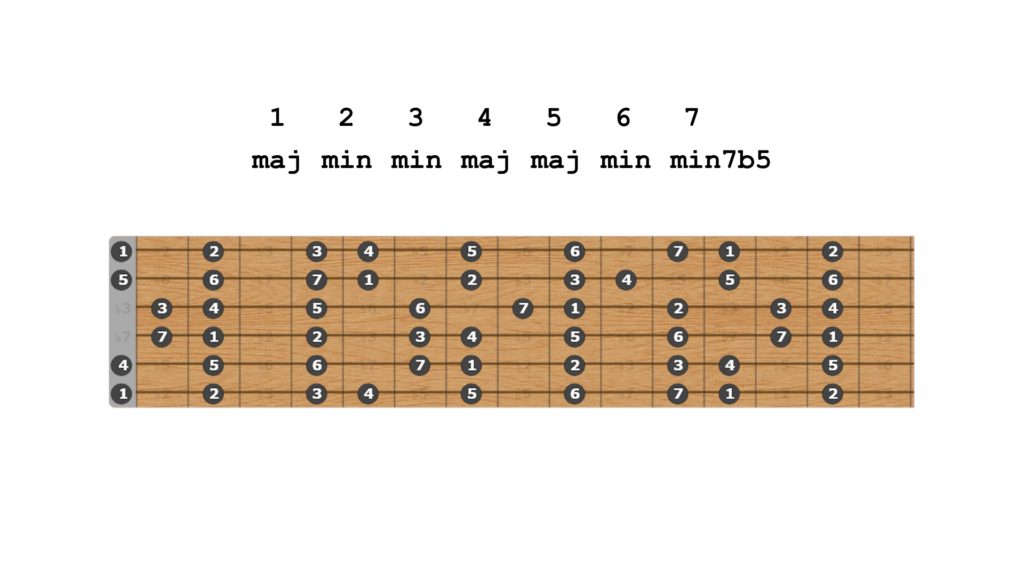
This is why learning the E-System matters. First, it takes you beyond the box—so you’re not stuck playing the same idea in the same spot. Second, it builds real chord understanding, so you can create and explore instead of only repeating what you’ve memorized. Third, it opens up modes in a way that leads to more interesting and nuanced melodies. And maybe most importantly, it brings simplicity: fewer random finger positions, more context and meaning.
The E-System is also “guitar-oriented theory.” It’s not piano theory awkwardly pasted onto the fretboard. It respects the nature of the guitar and uses a perspective that fits how the instrument is actually laid out. The result is flexibility: a small set of foundational concepts that can produce an extensive array of chords and melodic options.
Once you’ve adopted the E-System perspective and basics, Guitar Syntax is the next step—the key to fretboard freedom.
If the E-System gives you the building blocks, Guitar Syntax explains how those blocks interact on the guitar itself. It’s a set of rules that forms practical relationships between string names, the five basic chord shapes, the four chord types, and the seven interval numbers.
Think of Guitar Syntax as the language of the fretboard. When you understand the language, you can navigate with ease and precision instead of guessing. You can move across the entire neck and know what chord belongs where according to diatonic harmony. That’s the moment where the guitar stops feeling like a collection of tricks and starts feeling like a system you can actually speak.
Put together, the promise of the E-System and Guitar Syntax is simple: unlock the fretboard, connect the dots, and get out of boxes. You start constructing instead of memorizing. You gain clarity, and that clarity gives you the freedom to improvise, compose, create, and explore.
There is Guitar Syntax community on skool platform, where I teach this. You are welcome to join us.